

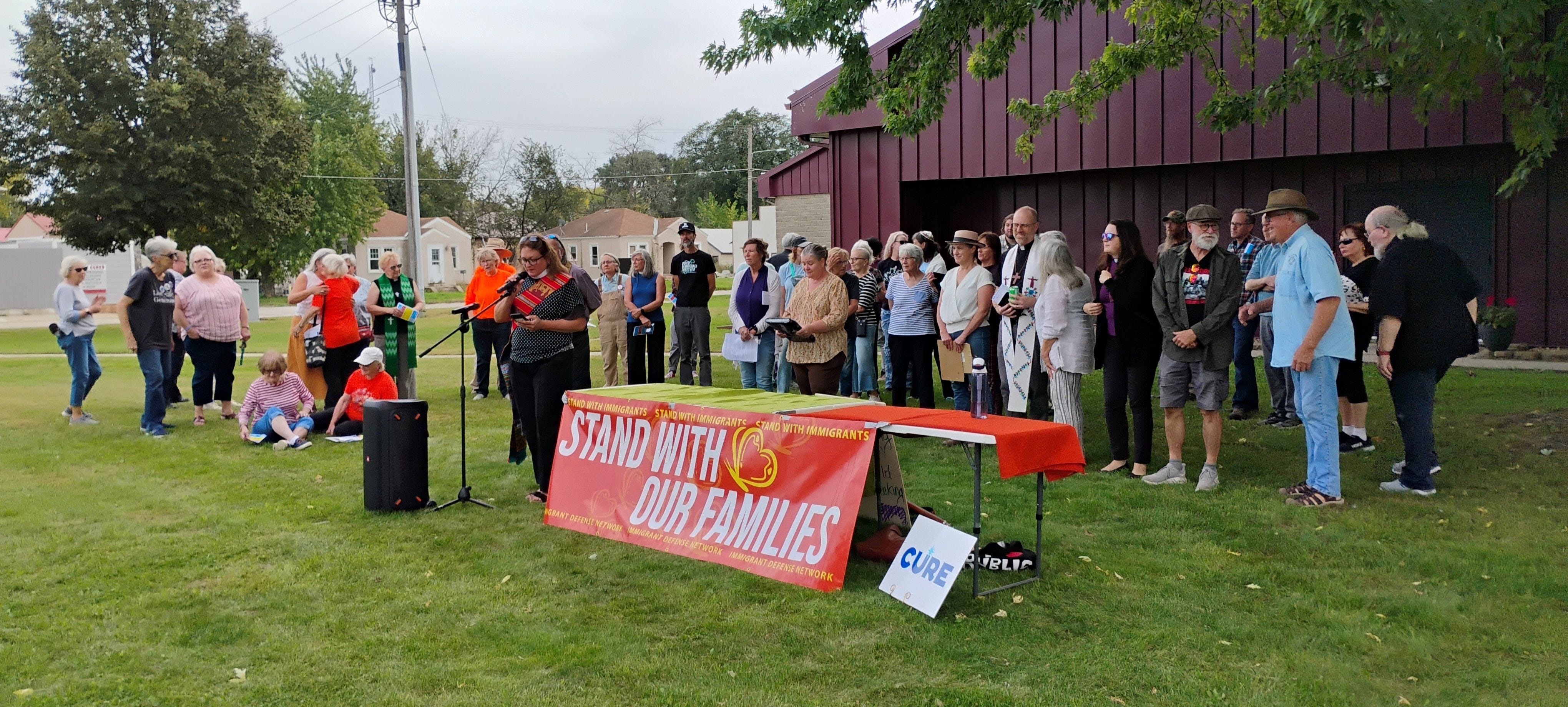
My partner and I attended the prayer vigil on Tuesday in Appleton that I’d posted about in advance in September 30: Appleton ICE Detention Center Prayer Vigil.
It was prayerful and quietly moving.
Here’s sponsor CURE’s Statement on the Potential of an ICE Detention Center in Appleton:
CURE stands with clergy, immigrant leaders, and community allies in strong opposition to the reopening of the Prairie Correctional Facility in Appleton, MN, as an ICE detention center.
Reopening this prison—owned by CoreCivic, a private prison corporation with a history of reports of mismanagement, unsafe conditions, and detainee abuse—would violate our deepest humanitarian and spiritual values. At full capacity, the 1,600-bed facility would hold more people than the entire population of Appleton, transforming this small rural community into a site of mass incarceration rather than a place of welcome.
Private detention centers like this are unjust and unsafe. Across the country, private ICE facilities have a history of overcrowding, inadequate medical care, and preventable deaths. Many immigrants may be held without due process, and detained people are often exploited for labor at less than $1 per day. Reports also confirm poor working conditions for staff at other private detention facilities, and it is unclear whether any jobs provided by a reopened private detention facility would have significant impacts for the local economy.
Instead of investing in housing, childcare, and workforce development—needs that Appleton families already struggle with—this plan enriches a private prison company that would likely extract millions of taxpayer dollars annually from this facility, profiting from the pain of others.
For more than a hundred years, rural Minnesota has been stronger because of immigrants. They help keep our schools open, strengthen healthcare services, open small businesses, and provide essential workforce support. A private ICE detention center in Appleton undermines these contributions and misrepresents who we are as Minnesotans.
Thus far CoreCivic has failed to be transparent with Appleton residents and local officials. Rumors, incomplete information, and quiet facility upgrades suggest the company is preparing for a contract with ICE without engaging the public. Our community deserves clarity, honesty, and a voice in decisions that will define our future.
To ensure that voice is heard, our coalition is hosting a Public Meeting on Wednesday, November 5 to provide accurate information, answer questions, and give Appleton residents the space to speak out. Together, we can demand accountability from CoreCivic and work toward solutions that strengthen community, not sacrifice rural values for extractive profit seeking.
Supporting Resources
On its Facebook page, CURE noted:
Close to 100 clergy & community allies gathered yesterday, united in peace, prayer & concern for all of our MN neighbors, to oppose the reopening of the Prairie Correctional Facility in Appleton, MN, as an ICE detention center. The Prairie Correctional Facility, owned by CoreCivic, poses a threat to our values, our community, and our future. It would turn a small rural town into a site of mass incarceration, profiting from pain, not progress. We demand transparency, accountability, and real investment in Appleton’s families.
In the media, Tom Cherveny reported for Fargo Forum Communications network paper the West Central Tribune (Willmar) article Coalition opposes reopening Appleton, Minnesota, prison as ICE facility:
APPLETON — A coalition opposing the possible reopening of the Prairie Correctional Facility as a U.S. Customs and Immigration Enforcement detention center called on Appleton civic leaders to pause their conversations with the private prison company.
“We ask city officials to set aside any plans for the Prairie Correctional Facility and instead partner with residents and community groups to invest in Appleton’s future, focusing on community and not detention,” said Therese Quinn, an Appleton area resident.
The possible reopening has thrust the small community into the national debate over immigration policy and the escalation of enforcement: As speakers decried the possible reopening, a white pickup truck with two American flags and a sign “Welcome ICE” circled the area a few times.
One community resident voiced her support for the facility’s reopening to the Rev. Jeffrey Fitzkappes of Trinity Lutheran Church, an ELCA parish in Montevideo, moments after he addressed the crowd.
“We recognize the difficulty this may cause economically in this and surrounding communities,” said Fitzkappes when speaking to those who gathered. “And we gather together to find new ways forward for the prospering of all people. But we will not accept money that comes with human cruelty.”
It was a theme repeated by religious leaders who spoke at the rally. “Prisons are built for punishment, not for people seeking safety,” said Archdeacon Rena Romero of the Episcopal Church in Minnesota.
The possibility of the use of the Prairie Correctional Facility by ICE became public when the Washington Post reported earlier that it was on a list of sites being considered by the federal agency. Congress has allocated $45 billion for new detention centers in recent legislation.
Organizers of the rally said they believe CoreCivic is in the process of preparing the Appleton facility for its use by ICE. Just over a week ago, a helicopter was used to lift materials onto the facility’s roof. . . .
Read the rest at the West Central Tribune.
Reporting for KARE 11, Jennifer Hoff reported in A community pushes back against plans to reopen state’s only private prison as ICE detention facility:
APPLETON, Minn. — Some community members are pushing back on plans to reopen an Appleton prison to serve as an immigration detention center and held a rally outside City Hall Tuesday.
The Prairie Correctional Facility, the only private prison in Minnesota, closed in 2010. Its owner, CoreCivic, says some staff remain on site and help maintain the building that can house about 1,600 people.
In a new statement to KARE 11, a CoreCivic spokesperson wrote, “We continue to explore opportunities with our government partners for which our Prairie Correctional Facility could be a viable solution.”
Clergy, immigrant leaders, and community members also called for humane alternatives to immigrant detention and delivered a letter to local officials, asking for a meeting with community members in November.
“What we are seeing is not compassionate, it is not dignified,” said Evangelical Lutheran Church of America Bishop Jen Nagel. “It is not what we hope for.”
Other residents admit the prison’s closure was a detriment to the community and support its reopening to revive the local economy, including Julie, who wouldn’t give her last name. Julie told KARE 11 reporter Jennifer Hoff her husband worked at the prison for 18 years. . . .
The Washington Post has reported the Trump administration wants to double the number of available beds from 50,000 to 100,000 and is eyeing opening facilities, not just in Minnesota, but North Carolina, Tennessee, Oklahoma and Indiana.
Congress recently approved $45 billion for detention centers over the next five years, according to the Post, which is more than the last three administrations combined. . . .
The coalition at Tuesday’s rally is asking city officials instead partner with residents and community groups to invest in Appleton’s future.
The meeting is tentatively scheduled at ‘52 Wing Gymnasium & Auditorium on Wednesday, November 5 at 6:30 p.m.
In August, Appleton City Administrator John Olinger says right now, the city is not in talks with CoreCivic or ICE. In a statement, Olinger had written, “We have also heard the rumors and confirmed with our contact at CoreCivic that they do not have a contract with ICE, but are pursuing a contract.”
Swift County also confirms it has not been contacted by CoreCivic or ICE. . . .
Here’s the YouTube of the broadcast:
The headline for the coverage Minnesota Reformer’s Madison McVan took a slightly different slant: Possible opening of ICE detention center in Minnesota sparks protest.
Her article was the regular solid work:
Fifteen years after a 1,600-bed private prison in west central Minnesota shuttered, the Trump administration is considering reopening the facility as an immigrant detention center.
Internal Immigration and Customs Enforcement records obtained by the Washington Post in August named the vacant Prairie Correctional Facility in Appleton as a piece of the plan to expand immigrant detention capacity to more than 100,000 beds by the end of the year — about a 66% increase from April.
Faith leaders from across the state joined Appleton residents in a prayer vigil in protest of the prison’s potential reopening Tuesday. One resident, with supporters in tow, delivered a letter to local leaders, signed by a number of faith leaders and immigrant rights organizations, opposing the detention center plans and requesting transparency.
“Appleton, frankly, is going to be a real hotbed of resistance,” said Rev. Daniel Romero of Disciples Public Presence, a social justice and advocacy ministry of the Christian Church Disciples of Christ.
The documents obtained by the Post were preliminary plans and were still in flux at the time of reporting, but the prison’s owners, CoreCivic, and ICE have not denied the reports.
Appleton City Administrator John Olinger told MPR News in August that CoreCivic was “aggressively pursuing” a contract with ICE.
ICE and its enforcement and detention tactics have become a flashpoint as the Trump administration attempts a mass deportation campaign, while human rights activists and civil libertarians demand more scrutiny and accountability.
On Tuesday, for instance, U.S. District Court Judge William Young, a Reagan-appointee, slammed the Trump administration for using deportations as a way to stamp out the free speech rights of immigrant pro-Palestinian demonstrators. He called the conduct of the administration unconstitutional and “a thing virtually unknown to our constitutional tradition.”
In a statement to the Reformer, an ICE spokesperson said the agency “is indeed pursuing all available options to expand bedspace capacity.” The Republican megalaw passed in July boosted funding for immigrant detention and deportation by $176 billion, with $45 billion set aside for expanding detention capacity.
CoreCivic spokesman Brian Todd said the company “continue(s) to explore opportunities with our government partners for which our Prairie Correctional Facility could be a viable solution.”
Prairie Correctional Facility was Minnesota’s only private prison until it shut down in 2010. A state law passed by the DFL-Legislature in 2023 bans private prison contracts at the state level — but won’t impact the federal government’s efforts to establish a private detention facility in Minnesota.
The resistance is certainly present — if not widespread — in Appleton, which Trump won in 2024 by 27 points. As dozens of people gathered to sing and pray together in the green space next to Appleton City Hall, a truck circled the block with an American flag flying and a “WELCOME ICE” sign.
One woman stopped by to heckle the group.
Speakers at the vigil cited moral and religious opposition to Trump’s increased immigration enforcement. They criticized CoreCivic over allegations of violence, sexual abuse and understaffing at its facilities. And they called on local officials to meet with local residents and faith leaders before approving the reopening of the facility.
This Minnesota Reformer story is republished here under Creative Commons license CC BY-NC-ND 4.0.
One Minnesota legislator isn’t hearing their prayers. In a Minnesota House District 12A News email update, Representative Paul Anderson, R-Starbuck, said:
Last summer, I co-signed a letter with Sen. Torrey Westrom urging the state to pursue re-opening the Prairie Correctional Facility in Appleton as a common-sense solution to make up for lost beds with the phased closing of the prison in Stillwater.
The subject of re-opening the Prairie Correctional Facility – Minnesota’s only private prison, which closed in 2010 – has gained momentum amid reports it could become an ICE detention facility. While the federal government’s plans remain uncertain, Prairie Correctional owner CoreCivic reportedly is “aggressively pursuing” a contract with ICE. Also, it remains to be seen how the federal government’s shutdown that just began Wednesday may impact planning.
If additional space is needed to house detainees, it would make sense to use Appleton’s 1,600 available beds instead of spending an untold amount of taxpayer money on new facilities. Not only would it be a cost-effective option, but it would restore a number of good-paying jobs in our region and provide a boost for the people of Appleton. . . .
Lovely.
Photo: After the prayers, the attendees gathered for a photo. Photo by Sally Jo Sorensen.
While you can become a paid subscriber to Bluestem Prairie through the link at the bottom of this post, and I encourage both unpaid and paid direct subscriptions, you can also mail contributions (payable to Sally Jo Sorensen, 600 Maple Street, Summit SD 57266) to support my work.
Or you can contribute via this link to paypal; use email sally.jo.sorensen@gmail.com as recipient.
I’m on Venmo for those who prefer to use this service: @Sally-Sorensen-6.
Bluestem Prairie is a reader-supported publication. To receive new posts and support my work, consider becoming a free or paid subscriber.